 EN
EN

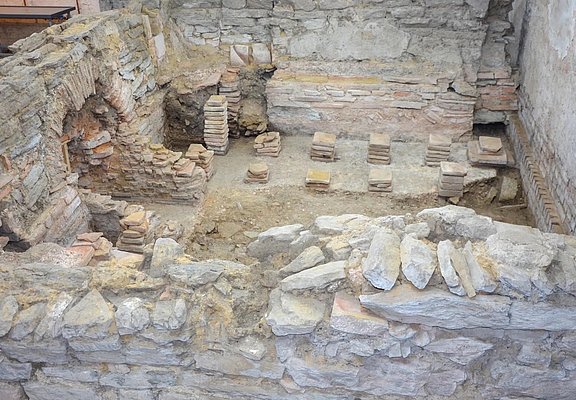
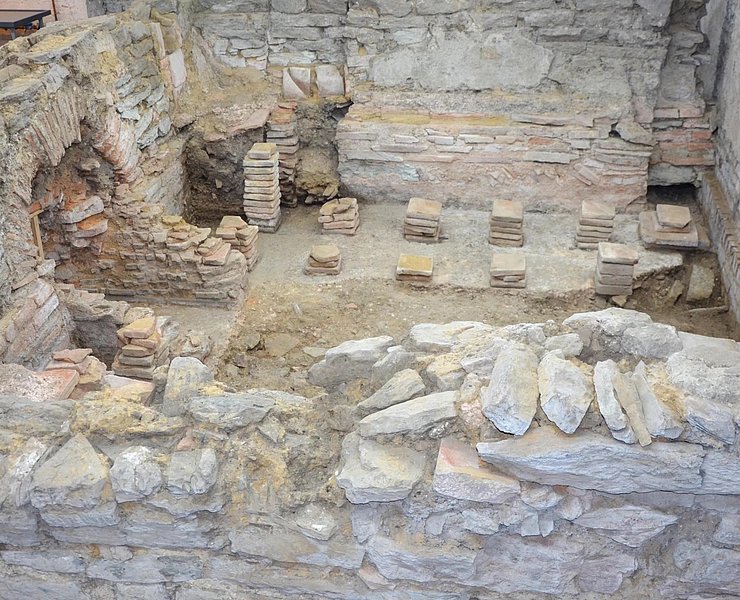
Ehemaliges römisches Kastell RIGOMAGVS
Remains of the former RIGOMAGVS fort, which was built around the turn of the millennium and existed until the 5th century AD, can still be recognised in Remagen's townscape today and can be visited at various locations.
The RIGOMAGVS fort was located on an important road towards Cologne and Mainz at the northern end of the Rhenish Slate Mountains. It acted as a barrier at the transition to the Lower Rhine region. The fort existed for almost 450 years from around 5 BC to around 450 AD. The presence of five different troops (cohorts) has been proven by inscriptions on bricks and gravestones. The civilian settlement (vicus) extended over a large area to the east and south-east of the fort. It was built at the same time as the fort. It is likely that the settlement also existed until the 5th century AD. The cemeteries were located along the roads leading out of the settlement to the east, south-east and west. Graves from the early 1st century AD were found. The most recent graves date from the 5th/6th century AD from the Merovingian period.
A Roman gravestone found in Remagen is a special find. It bears witness to the fact that a 35-year-old soldier named Dasmenus from what is now Serbia was buried in Remagen. The stone dates from between 40 and 69 AD.
The Roman remains are now almost completely built over by the modern city. However, the location of the fort and the course of the Roman roads are still partially recognisable in today's cityscape. The fort, civilian settlement and burial grounds are located in today's urban area in the district of Remagen.
Since July 2021, the Roman finds in Remagen have been a UNESCO World Heritage Site as part of the Lower German Limes.
- Attractions













Contact us
Ahrtal-Tourismus Bad Neuenahr-Ahrweiler e.V.
Oberstr. 8
53474 Bad Neuenahr-Ahrweiler
Tel.: 02641 / 9171-0
info@ahrtal.de

